



In my work advising boards around strategy, AI and transformation, one thing has become abundantly clear in recent years: AI is no longer a technical project sitting three levels down in the organisation. It is now a strategic force that shapes cost, pace, innovation, risk, trust, and competitive position.
Yet most leadership teams cannot answer a fundamental question: What level of AI adoption are we aiming for?
This sounds simple. It isn’t. Many organisations jump between isolated use cases without a clear direction. Some chase hype. Others avoid action due to fear of risk. The result is the same: confusion, slow progress, and little value delivered.
To help organisations understand the scope of their AI ambitions, I use a simple framework with my clients: the Four Levels of AI Automation. It shows how AI can reshape personal work, operations, products, and whole business models. Each level brings new expectations for leadership involvement, data requirements, in-house capabilities, risk, and governance.
This article explains the four levels in clear terms. It includes real examples and straightforward guidance for board oversight. No buzzwords. No over-the-top promises. Just a clear roadmap that shows where you are, what comes next, and what you need to do.
Level 1: AI for Personal Productivity & Decision-Making - The Co-pilot Phase
At this level, AI tools are adopted by individuals to serve as intelligent collaborative partners, helping individuals work faster and make better decisions. The primary objective is to enhance the productivity, creativity, and effectiveness of knowledge workers by augmenting human tasks or providing rapid, data-informed decision support. Think of it as a smart aide. It drafts, summarises, plans, and checks. You stay in charge. The tool speeds you up and reduces cognitive load. It feels small, but it isn’t. If every knowledge worker speeds up by 20–40%, entire workflows change.
A CFO uses AI to draft board finance papers. She still checks everything, but she starts from a smarter first draft. Her team follow her lead. Cycle times dropped by days, and her analysts now spend more time on judgment and less on formatting.
A sales director uses AI inside his CRM to qualify the pipeline. It reviews inputs, flags missing data, and predicts which accounts might be at risk of slipping. The team catch risks far earlier.
A legal head uses AI to summarise case files and produce early contract outlines. It reduces time spent on admin and frees capacity for real thinking.
Leadership, accountability, and focus
At this level, leaders set the tone. If the CEO and executive team use AI, others will follow. If they avoid it, adoption dies. Leaders should model use cases in public. They should share how they use AI to read papers or prepare meetings. These signals change culture far more than a policy memo.
Accountability sits with functional heads. Their job is to redesign the daily workflow. AI only helps when people change how they work, not when they bolt a tool onto existing habits.
Organisational data readiness
The data requirement is low. AI tools can create value from basic inputs, but teams soon hit a wall when internal data is unclear, missing, or scattered. Level 1 exposes gaps that must be fixed later for Levels 2 and 3.
Proprietary model development
None needed. Off-the-shelf tools deliver strong returns, but guardrails matter. Staff must know when they can and cannot share sensitive content.
AI literacy
This is the highest return investment you can make at this stage. Teach people how to write prompts, check output, and make better decisions with AI. Most people use only 5–10% of the capabilities of the tools they have.
Governance and compliance
At this level, organisations must ensure clear rules for:
What data can be shared
When humans must check AI output
How quality should be reviewed
How prompts and outputs are monitored
Mistakes often happen through carelessness, not malice. Good governance prevents these problems before they become headlines.
This level represents the lowest-risk entry point for AI. Organisations should start here. It is fast to deploy, cheap to test, and easy to govern. Roll it out to knowledge workers first. Start with clear tasks: drafting emails, notes, briefs, slides, code, and simple analysis. Add guardrails, measure gains, prove value, build literacy, then expand the scope.
Level 2: AI for Efficient Operations - The Value Chain Optimisation Phase
This level focuses on applying AI across specific, established functional departments or points in the organisational value chain to drive measurable efficiency, cost reduction, and process improvement. AI systems are integrated into existing workflows to automate high-volume, repetitive tasks and optimise resource allocation. This is where things get interesting. The focus shifts from improving individual productivity to influencing core processes. You start redesigning how work flows across teams.
AI models run and improve core processes. They forecast, schedule, route, classify, and detect. They reduce waste and errors across Ops, Supply Chain, Finance, HR, and IT. Humans remain in control of the exceptions and own the outcomes. Pick high-volume, repeatable flows with clear targets. This is where material P&L gains show up.
Banks use AI to detect fraud, assess credit risk, and flag suspicious activity. These systems run thousands of checks per second and spot patterns that humans would miss.
Retailers use machine learning to predict demand, reduce overstock, adjust prices, and optimise delivery routes. The effect on the margin is real.
Manufacturers use predictive maintenance systems that tell engineers when a critical part will fail. Unplanned downtime drops. Safety improves.
A large insurer I worked with now uses AI to classify claims documents. Staff no longer sift through long reports. The system reads, tags, and routes each item. Case handlers focus on decisions rather than scanning PDFs.
Leadership, accountability, and focus
Ownership shifts to senior operational leaders. AI now touches throughput, cost, and risk.
KPIs must be clear:
Cycle-time
Accuracy
Cost-to-serve
Failure rates
The COO becomes a key sponsor. Cross-functional collaboration becomes essential because processes rarely fall neatly within a single department.
Organisational data readiness
Now data quality matters. Organisations need clean, structured, reliable datasets that connect across systems. If your ERP and CRM don’t speak to each other, AI will struggle. Leaders must treat data as infrastructure, not as a nice-to-have. Without this level of data readiness, Level 2 becomes slow and painful.
Proprietary model development
Many firms fine-tune models on their own data. You rarely need to build models from scratch.
Your advantage usually comes from strong pipelines, clear labels, and frequent updates.
AI literacy
Teams in operations need to understand:
How models behave
When to override predictions
How to spot drift
How to manage exceptions
These skills must sit across technology, risk, and business units.
Governance and compliance
As opportunity rises, risk rises with it. You now automate decisions that affect money, safety, and trust. This demands:
Model testing
Fairness checks
Documentation
Audit trails
Regulatory alignment
Clear human oversight
Boards should ask for evidence, not reassurance.
Level 3: AI for Innovative Value Propositions - The Product & Service Enhancement Phase
Level 3 marks a shift from internal efficiency to external value delivery. AI is used as a core component to fundamentally enhance the quality, personalisation, or capability of the organisation’s products, services, and customer interactions, creating tangible competitive advantages.
AI shapes the product and the experience. It personalises content, pricing, offers, and journeys. It powers service across channels. It becomes part of the product’s value, not just the back office. Use it where choice is vast, context shifts often, and speed matters. Media, retail, travel, telco, and banking are prime ground. Personalisation increases use, retention, and spend.
Streaming platforms personalise every user’s experience.
Retail banks offer AI-driven insights on spending, saving, and money habits.
Learning platforms supply AI tutors that adapt to each student.
Car manufacturers provide real-time alerts, predictive servicing, and assisted driving features.
I advised a firm that used AI to personalise every step of its customer onboarding. The system predicted the best sequence of actions for each client. This reduced drop-off by a third. The board had expected a modest uplift. Instead, they saw a dramatic shift in customers’ perception of the product.
This level turns AI into part of the product promise. Done well, it drives growth and loyalty. It becomes hard to copy because it relies on your data and your learning. It also raises the bar on ethics and accountability.
Leadership, accountability, and focus
The focus moves to product strategy. AI capability becomes a source of differentiation.
Ownership sits with the CPO and CTO, but the board must stay close due to customer impact, brand risk, and regulatory exposure.
The organisation must work cross-functionally. Product, engineering, data, marketing, legal, and risk teams must align. AI-driven features create new kinds of failure. Slow coordination kills momentum.
Organisational data readiness
Customer-level data must be accurate, linked, and accessible. Organisations need real-time flows, strong tagging, and consistent standards. Data privacy becomes a design constraint rather than an afterthought. Customers must have complete trust in how their data is used.
Proprietary model development
This is where proprietary models start to matter. The value lies in training on your own datasets: behaviour patterns, usage signals, support cases, equipment telemetry, or user feedback loops. Competitors cannot copy this without your data. This is the first point where AI creates a lasting strategic edge.
AI literacy
Product managers must understand how to build with AI. Designers must learn how users interact with conversational agents. Engineers need deeper model skills. This is not optional. If leaders do not understand AI at this level, they cannot govern it.
Governance and compliance
Customer-facing AI creates new classes of risk:
Inaccurate recommendations
Unfair outcomes
Unclear decisions
Hallucinations
Harmful advice
Breach of trust
Boards should require:
Impact assessments
Testing environments
Safety reviews
Monitoring dashboards
Red-teaming
Clear escalation paths
Level 3 offers high reward but also high exposure.
Level 4: AI for Disruptive Business Models - The Industry Reimagination Phase
This is the highest level of transformation, where AI is leveraged to create entirely new operating models, redefine industry structures, or capture new markets that were previously inaccessible. The focus moves beyond incremental improvement to leveraging proprietary AI capabilities as the foundational architecture of the business.
Here, AI is no longer a tool inside the business. It is the business. It enables new models, breaks cost curves, and reshapes value pools. Incumbents feel it in margins and share. New entrants scale fast. AI changes the unit economics or the speed of discovery. It creates experiences that were previously not feasible.
Consider autonomous vehicles. The entire economic model of transport changes when driving becomes software. Costs fall. Safety improves. Asset use rises.
Or think about factories run by autonomous systems. You no longer need large teams on the floor. Sensors, robots, and predictive systems handle most tasks. The cost structure collapses.
The typical pattern is clear: AI enables work to be done in ways that were previously impossible.
Leadership, accountability, and focus
This becomes a CEO and board-led agenda. These decisions affect the organisation’s entire strategy. They involve long-term bets, heavy investment, and new forms of oversight.
Leaders must have clear answers to:
What markets are we entering?
What risks do we accept?
How do we protect customers?
How do we manage liability?
What skills do we need?
What systems must we build?
Strategy becomes technology-led. Execution involves partners, regulators, and new ecosystems.
Organisational data readiness
Data becomes mission-critical. You need high-quality, real-time input streams, strong data governance, and monitoring that detects failure early. If the data is weak, the model collapses. If the model collapses, the business model collapses.
Proprietary model development
At this stage, many firms build advanced models or large R&D teams. The advantage comes from unique data, strong telemetry, and deep domain knowledge. These models often require new infrastructure and new talent.
AI literacy
Everyone must improve their skills. Executives need enough understanding to govern complex systems. The technical teams need world-class expertise. Product teams need to understand limits and failure modes. Risk teams need new tooling and new methods.
Governance and compliance
This is the highest-risk level. Failures become system-wide. A single model error can cause significant harm.
Boards should expect:
advanced safety frameworks
continuous audits
fail-safe design
independent review
crisis playbooks
regulatory engagement
Level 4 is where trust becomes a strategic asset.
This level is not a tech pilot. It is a strategic bet. It can redefine cost curves, cycle times, and customer norms. Treat it like a new business and build models with strong governance in place.
A Simple Way to Use This Framework
When I present this model to boards, I ask three questions:
1. Which level are we operating at today?
Most firms sit between Level 1 and Level 2.
A few reach Level 3.
Very few operate at Level 4.
2. What level are we trying to reach?
This forces clarity on ambition, risk appetite, and investment.
3. What must change in leadership, data, skills, and governance to get there?
This brings discipline and order to AI discussions that often spin in circles.
Boards find this grounding. Executives find it helpful because it cuts through noise. It gives both sides a shared ambition and language.
Summary
AI adoption is not one thing; it is a ladder. Each level changes what is possible and what is required.
Level 1: Personal Productivity
AI boosts individual output and judgment.
Leaders must model usage.
The focus is on literacy and safe practice.
Level 2: Efficient Operations
AI supports the value chain.
Operational leaders take control.
Data and process redesign matter.
Level 3: Innovative Value Propositions
AI shapes products and services.
It creates new customer value and a competitive edge.
Risks become public and must be governed carefully.
Level 4: Disruptive Business Models
AI rewrites industry rules.
Boards and CEOs must lead from the front.
The risks are high, but so are the rewards.
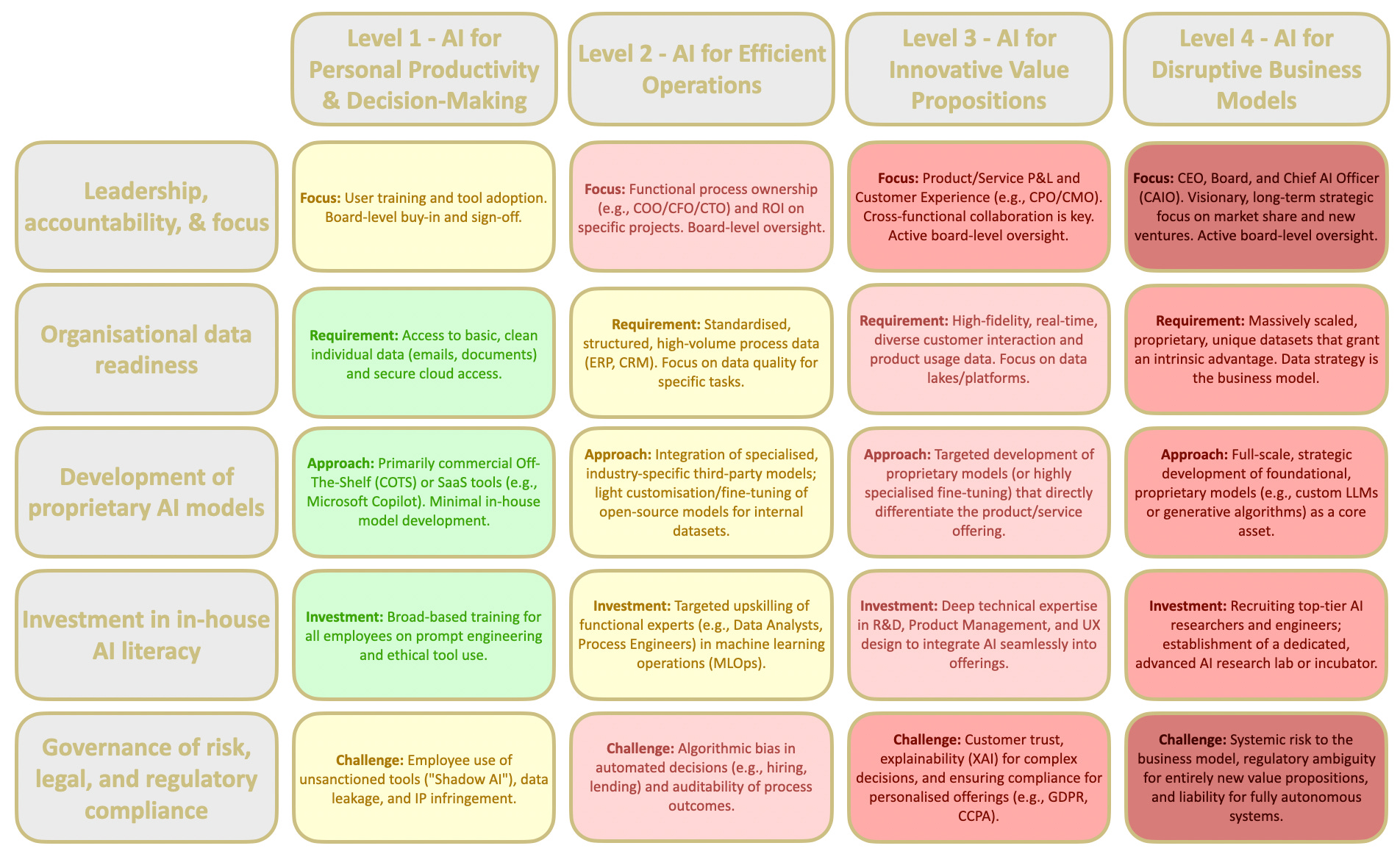
(download a PDF of the visual here)
The organisations that win treat AI as a leadership discipline, not a technical project. They build clarity, maturity, and strong governance at each step.
If you found this helpful…
👉🏽 Subscribe to AI in the Boardroom to get weekly insights, tools, and guidance on how directors and executives can use AI to strengthen strategy, improve oversight, and build stronger organisations.