



For many decades, boards and executives have worked together to define an organisation’s strategy. This undertaking has always required a clear vision, relevant data, and tough choices. The pace of change, the volume of available data, and the complexity of ecosystems are all increasing. According to McKinsey & Company, AI and generative AI are now “a new inflexion point in strategy design” that magnifies the capacity for insight and choice.
For boards and executives, this raises a dual challenge:
How do we embed AI into the strategic process so it strengthens rather than fragments our efforts?
How do we turn AI into a competitive advantage, not just cost savings or pilot inertia?
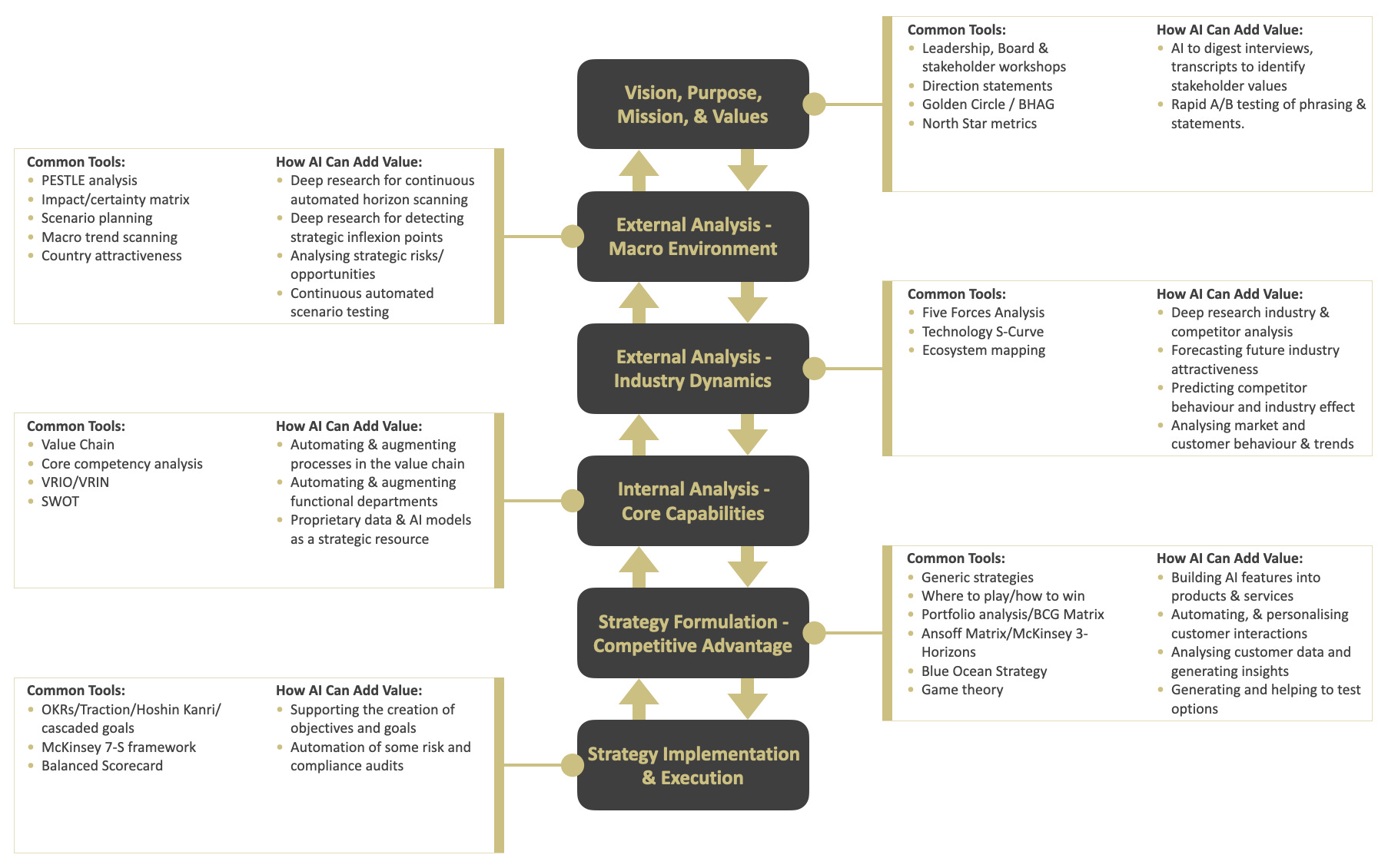
If you fail to address these challenges, you risk falling behind organisations that treat AI as foundational to strategy, rather than an add-on. There are many opportunities in the strategy process to embed AI tools. These include:
vision, purpose, mission, & values,
external analysis - macro environment,
external analysis - industry dynamics,
internal analysis - core capabilities,
strategy formulation - competitive advantage,
strategy implementation & execution,
risk, governance & ethical dimension.
We will explore each of these in turn.
Vision, Purpose, Mission & Values
A good strategy provides both a direction of travel and a high-level positioning. Before zooming in on tools and frameworks, you must start with direction. A strategy without an anchor will likely fail. A clear Vision, Purpose, Mission & Values (VPMV) sets the north star. Without them, you may apply AI tactically—but miss where to play and how to win. The board must ask: Does our VPMV still reflect AI-era realities?
Practical steps for boards
Conduct a workshop with senior leadership: examine the Vision statement through an AI lens. Ask: if AI doubles our data speed or automates major processes, does our Vision still reflect what we seek to become?
Use AI to test assumptions. For example, take transcripts of stakeholder interviews and run natural language processing (NLP) to identify emerging values or contradictions (we’ll return to this).
Define one or two ‘North-Star’ metrics tied to your AI ambition (see next section).
Once VPMV is refreshed, communicate widely: the board sets the tone, leadership drives.
Map your existing Mission (“We deliver customer-centric financial services”) and ask: if we embed AI, what shifts? Perhaps you become “We deliver real-time anticipatory financial services.” Then you test stakeholder sentiment—via AI-driven sentiment analysis of customer and employee feedback—to validate whether the shift resonates.
How AI can help
Use AI to digest interviews, customer feedback, and leadership round-tables to identify stakeholder values and tensions.
Run rapid A/B testing of different phrasings of Vision and Mission statements: show them to random internal/external audiences, measure sentiment, clarity and resonance.
Use generative AI to draft alternative Mission/Value statements, then review and refine with the board.
That embeds AI into the core of strategic grounding — not as an afterthought.
External Analysis – Macro Environment
Strategy must start outward. What is happening in the world that could affect you? What is the likelihood and impact of each identified threat or opportunity? What will you do to mitigate or capitalise on each of them?
Common tools
PESTLE (Political, Economic, Social, Technological, Legal, Environmental) analysis
Impact/Certainty matrix (which trends are high-impact & high-certainty)
Horizon-scanning
Scenario planning (extremes plus central cases)
Country attractiveness when operating internationally
How AI could add value
Use AI tools to continuously automate horizon scanning: monitor news, regulations, geopolitical signals, and industry commentary to flag signs of change. Deep research can be an excellent tool for this, and can do in a few minutes what would take a consultant weeks, and at a fraction of the cost.
Detect strategic inflexion points: e.g., a regulatory shift in AI governance, or a new entrant disrupting with a business model.
Use simulation or generative modelling to test different macro-scenarios and their impact on your business.
Quick “what-if” models: if interest rates rise and AI adoption doubles in X segment, what’s the effect on your cost base or competitor speed?
Example anecdote
A major infrastructure services company used an AI-driven platform to scan regulatory filings, patent filings and global news feeds. It flagged a shift in Chinese infrastructure financing 12 months ahead of their internal PESTLE review. The board then scheduled a scenario planning day and reallocated strategy time to that region.
Why boards should care
Often, boards receive a static macro environment slide deck once a year. AI enables living insight. For non-executive directors, the questions become:
Are we asking the right questions of management around these signals?
Do we require updates on horizon-scanning and scenario shifts at each board meeting?
Are we prepared for both opportunity and risk at the macro level?
External Analysis – Industry Dynamics
Zoom in: what’s happening in your specific industry? Who are the main competitors, suppliers, and customers? What changes are coming?
Common tools
Porter’s Five Forces analysis
Technology S-Curve (where is the adoption tipping point?)
Ecosystem mapping (partners, competitors, new entrants, regulators)
How AI could add value
AI can speed up competitor and industry analysis by scraping public filings, news feeds, and patent databases, and by building competitor profiles.
Predict future industry attractiveness: AI can model adoption curves, supply-chain shifts, and customer behaviour trends.
Analyse market/customer behaviour: apply AI to internal and external customer data to spot shifts earlier.
Strategic “game-theory” modelling: what likely moves will our competitors make if they embed AI?
Example
An insurance board asked: “What happens if a fintech start-up uses AI to undercut us on risk assessment and pricing?” Using AI competitor mapping and scenario modelling, they estimated a 15-per-cent erosion of premium income within 36 months if they did nothing. They then accelerated their AI-embedded product launch accordingly.
Board considerations
Are we adjusting our Five Forces analysis to include AI as a force (e.g., AI lowering switching costs and creating new-entrant threats)?
Do we have metrics to monitor our position on the S-Curve of AI adoption in our industry?
Does our ecosystem map include new nodes enabled by AI (data partners, ecosystem incumbents, regulatory technology)?
Internal Analysis – Core Capabilities
Having looked outside, we now look inside at ourselves. What do we have and what do we need? What are our key resources and capabilities that give us our unique competitive advantage?
Common tools
Value Chain analysis
Core-competency identification
VRIO/VRIN framework (Value, Rarity, Imitability, Organisation)
SWOT (Strengths, Weaknesses, Opportunities, Threats)
How AI could add value
Automate or augment processes in your value chain: e.g., AI in procurement, logistics, marketing, and service.
Use AI models and proprietary data as strategic resources that competitors cannot easily replicate.
Use AI to analyse your internal capability gaps: for example, talent, data architecture, governance, culture.
Real-time dashboards using AI to monitor internal performance, identify bottlenecks and run early-warning indicators.
Example
A retail business used AI to map its end-to-end value chain, overlaying internal data flows and external customer touchpoints. It was discovered that its data capture in the last-mile delivery segment was weak, making targeted AI-enabled personalisation impossible. The board mandated investment in data capture, which enabled a differentiator in customer loyalty.
Board questions
What parts of our value chain are subject to automation or augmentation via AI, and what does that mean for our business model?
Do we treat our data, AI models, and workflows as strategic assets (i.e., VRIO)?
How well are we organised for AI: talent, infrastructure, governance, culture?
Are we monitoring internal capability gaps and addressing them proactively?
Strategy Formulation & Competitive Advantage
This is where it all comes together. Having analysed vision, the external and internal environment, you can now choose where to play and how to win—and build competitive advantage.
Common tools
Generic strategies (cost leadership, differentiation, focus)
Where to play / How to win frameworks
Portfolio analysis / BCG Matrix
Ansoff Matrix / McKinsey 3‑Horizons Framework
Blue Ocean Strategy
Game-theory modelling
How AI could add value
You can build AI features into products and services: making the offering smarter, more adaptive, more valuable.
Personalise customer interactions at scale: using AI to tailor experiences, offers, and service.
Use AI to simulate “what-if” strategies: test different business models, pricing, customer segments, and service levels rapidly.
Automate insights from customer behaviour and generate novel strategic options: AI can surface patterns humans miss.
Example
A healthcare company asked: “Should we enter diagnostics as a service using AI?” They used scenario modelling with AI to evaluate market sizes, reimbursement risks, and ecosystem partners. They then decided to adopt a “focus-plus-differentiation” strategy: target a niche segment (chronic disease diagnostics), use AI for predictive detection and partner with digital health platforms. The board reviewed the models, agreed on the strategy, and allocated resources accordingly.
Key for boards
Make the hard choices: where will we play, how will we win? AI supports, but does not replace judgment.
Ensure resource allocation aligns: AI investments must map to strategic choices and the business model.
Monitor strategic options as dynamic: AI changes can shift “how to win” faster than in past eras.
Strategy Implementation & Execution
A strategy is only as good as its implementation. Boards must ensure execution, not just ambition.
Common tools
OKRs (Objectives & Key Results)
Hoshin Kanri / Traction / Cascaded goals
McKinsey 7‑S Framework
Balanced Scorecard
How AI could add value
AI can support the the creation of objectives and goals by using historical data and scenario modelling to set realistic yet stretching OKRs.
AI can automate risk and compliance audits: freeing leadership to focus on value, while governance remains robust.
Real-time monitoring and dashboards: AI-driven tools alert boards or executives when strategy drift occurs.
Continuous feedback loops: AI models learn from execution data and refine strategic metrics or goals.
Example
A manufacturing firm used AI to monitor the execution of a cost-reduction strategy. The board set OKRs focused on efficiency, customer lead time, and service level. The AI platform tracked thousands of sensor data points and flagged when a production line was deviating. This allowed leadership to intervene early rather than wait for the quarterly report.
Board checklist
Are strategy implementation metrics aligned with AI-capable monitoring?
Does our governance oversight include dashboards that use AI-driven signals for early warning?
Do we have a clear cascading of goals (board → executive → function) with AI-aware measures?
Is our organisation structured (7-S) to embed AI: shared values, skills, systems, style, staff, structure, strategy?
Risk, Governance & Ethical Dimensions
This thread runs across all the stages above. Boards cannot ignore it. Research shows that firms with strong governance around AI build greater trust and can convert it into a competitive advantage. For example, according to EY, companies that embed responsible AI practices gain a premium in stakeholder trust and long-term value.
IBM asserts responsible AI is a differentiator in competitive markets: it strengthens brand, attracts talent, and retains customers.
Practical board mechanisms
Establish an AI oversight committee (or designate board sub-committee) linking strategy, risk, ethics and technology.
Set AI literacy expectations: directors need basic knowledge of AI capabilities, risks and architecture—the board article on governing AI underlines this.
Embed ethics, fairness, and transparency metrics into the balanced scorecard.
Require scenario testing of AI failures/risk events (e.g., data bias, model drift, regulatory shock).
Link AI strategy to enterprise risk management (ERM): AI is not separate; it’s at the heart of many risks (operational, reputational, strategic).
Actionable Tips for Boards & Executives
Start with a one-pager. At your next board meeting, ask: “How does AI affect each element of our Vision & Values?” Use this as a catalyst for deeper reflection.
Require an AI-strategy briefing. Ensure management presents how AI will support strategy formulation and execution—not just “pilot projects”.
Ask for a capability heat-map. Request from leadership a map of AI readiness across people, data, models, infrastructure, and culture.
Set a board dashboard. Insist on a simple, high-level AI-strategy dashboard: adoption metrics, value delivered, risk indicators, model drift alerts.
Embed scenario planning. Make AI-driven scenario modelling part of your regular strategic review cycle. Choose at least one “wild card” scenario (e.g., regulatory shock in AI, competitor uses AI to halve cost).
Focus on value, not hype. Don’t let AI become a distraction from core strategy. Ask: “What business value will this deliver? How will we monetise it or build differentiation?”
Monitor sustainability. Competitive advantage from AI can be fleeting unless you embed systems, data, culture, and governance. Ask: “Can our competitors copy this within 18-24 months?” If yes, you need a new edge.
Summary
Boards and senior leaders must treat AI as a strategic instrument, not an optional tool.
You begin with Vision, Purpose, Mission & Values, then map the macro and industry context, assess internal capabilities, formulate strategy, and execute it—all with AI in mind.
From horizon scanning to internal dashboards, from scenario modelling to value chain automation, AI offers both opportunities and risks.
Your job as a director or executive: ask the right questions, insist on clarity of value, allocate resources, monitor execution and governance, and ensure that AI becomes a sustainable competitive advantage, not just noise.
👉🏽 Download a handy AI for Strategy & Competitive Advantage One-Pager.
👉🏽 If you found this useful, subscribe to AI in the Boardroom. You’ll receive future deep-dives packed with actionable insights on AI strategy, governance, transformation and board oversight. Let’s make AI a source of strength—not risk—for your organisation.
Couldn't agree more. AI is a true inflecxion point. Your analysis is alwais spot on.