


Why boards must treat AI as a core competence, not a vendor service
In 2000, Toys “R” Us made a decision that looked sensible at the time. It partnered with Amazon to run its online sales. The logic was simple: Amazon was good at e-commerce, Toys “R” Us was good at toys. Let the specialist handle the technology.
A few years later, the channel became the market. The firm that had outsourced its digital capability no longer controlled the most important part of its business model. When the partnership unravelled, Toys “R” Us found itself without the internal muscle to compete in a world it had helped create.
This pattern repeats. Boeing outsourced large parts of its software engineering and system integration, hollowing out the very capability needed to assure safety in complex aircraft. Ford allowed vehicle software to fragment across hundreds of supplier-built modules, then discovered that speed, integration, and innovation had become impossible to orchestrate. In each case, what was once seen as “support” quietly became strategic. By the time leadership realised, the organisation no longer owned the competence required to respond.
AI now sits at the same inflexion point.
Many boards still treat AI as a technology to be procured, piloted, and rolled out. In reality, AI is becoming a general-purpose production and decision-making system that spans the entire enterprise. It shapes how products are designed, how prices are set, how risks are assessed, how customers are served, and how capital is allocated. Once a capability reaches that position, it is no longer an IT concern. It becomes part of the firm’s competitive identity.
Strategy, at its core, is not a plan. It is the set of decisions, assets, and capabilities that allow a company to do things rivals cannot, at a speed and quality they cannot match. You can outsource tasks. You cannot outsource the capability on which your advantage depends.
AI and the logic of core competencies
The idea of a “core competence” is simple. Some capabilities do more than support operations. They underpin multiple products, shape how the firm competes, and are difficult for others to copy. These capabilities deserve long-term investment, executive attention, and board oversight because they define what the organisation is.
AI increasingly meets all three tests.
It is not confined to a single product line. It cuts across marketing, operations, finance, risk, and R&D. It is not a marginal efficiency tool. It influences cost curves, service levels, speed of innovation, and the quality of decision-making. And when built on proprietary data, domain knowledge, and organisational learning, it becomes hard to replicate.
This is where the resource-based view of the firm becomes useful. Sustainable advantage comes from resources and capabilities that are valuable, rare, hard to imitate, and embedded in organisational systems. Generic AI services accessed through an API fail this test. They are widely available, easily copied, and outside the firm’s control. In-house AI capability built on proprietary data, tailored models, and disciplined operating routines can meet it.
Michael Porter’s value chain offers another lens. Competitive advantage is realised through activities: how the firm designs, builds, sells, and supports its products and services. AI now sits at the heart of many of these primary activities. It shapes demand forecasting, pricing, production planning, customer interaction, fraud detection, credit assessment, and compliance monitoring. When a capability permeates the value chain, it cannot be treated as a peripheral service. It becomes part of the way the firm creates value.
Once a capability reaches that point, the strategic question is no longer “Which vendor should we use?” It becomes “Do we own the competence to design, govern, and evolve this capability ourselves?”
Three levels of AI adoption, three strategic positions
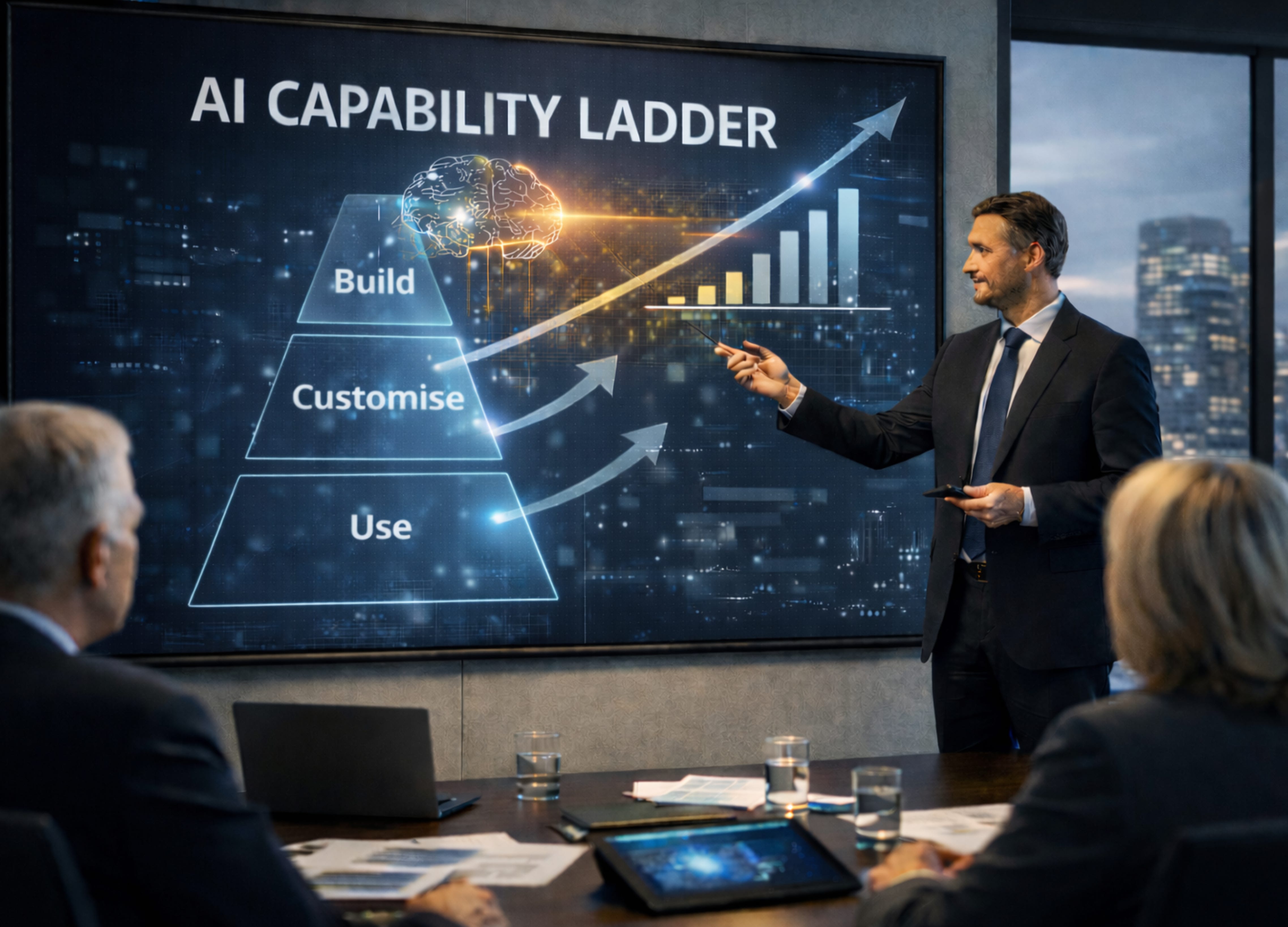
Most organisations move through distinct stages in their use of AI. Each stage carries different implications for control, learning, and advantage.
Level 1: Using general models
At this stage, firms consume foundation models through standard interfaces. They build chatbots, automate document processing, and support knowledge work. Time to value is short. Costs are variable. Differentiation is minimal. Learning is limited because the underlying models, data pipelines, and evaluation methods are owned by someone else.
This is a sensible place to start. It is not a place to stay.
Level 2: Customising and fine-tuning
Here, organisations adapt general models using their own data. Performance improves. Use cases become more specific. Some intellectual property is created. Yet architectural control, safety mechanisms, and core learning loops remain external. Dependence on vendors persists. Switching costs rise. Strategic freedom remains constrained.
Level 3: Building and operating in-house capability
At this level, the firm owns the data architecture, model lifecycle, evaluation standards, and deployment pipelines. It may still use external cloud platforms and open models, but it controls how intelligence is trained, tested, monitored, and integrated into business processes. It develops its own talent, tools, and governance routines. Learning compounds over time.
This is the point at which AI becomes a core competence rather than a purchased feature.
The strategic distinction between these levels mirrors the distinction between renting capacity and owning capability. The former enables experimentation. The latter enables sustained advantage and effective governance.
Toys “R” Us: when a channel becomes the business
The lesson from Toys “R” Us is not about e-commerce. It is about misclassifying a strategic capability as a support function. Many organisations, and sadly consultancies, still make this mistake.
By outsourcing its online presence, the company also outsourced customer data, experimentation, and the learning cycles that would later define retail competition. When digital became central, it no longer possessed the skills, systems, or culture needed to adapt. The cost was not just lost revenue. It was lost strategic freedom.
AI now plays a similar role. For many firms, it is moving from a productivity tool to the primary interface between the organisation and its customers, employees, and partners. If that interface is built, trained, and controlled elsewhere, the firm may retain operational access but lose strategic agency.
Boeing: outsourcing engineering judgment
Boeing’s difficulties reveal a different dimension of the same issue. Complex systems demand system-level understanding. When software development and integration are fragmented across suppliers, knowledge becomes dispersed, accountability blurs, and management loses the ability to interrogate risk with confidence. Technical assurance becomes contractual rather than intrinsic.
AI systems exhibit similar characteristics. They are probabilistic, adaptive, and deeply dependent on data quality and operational context. If the organisation cannot inspect model behaviour, test failure modes, and understand interactions with other systems, governance becomes symbolic. Boards remain accountable for outcomes they cannot truly oversee.
Owning AI capability is not only about competition. It is about control.
Ford, Tesla, and the Chinese EV manufacturers: software as the product
Ford’s public acknowledgement of its software challenge markeda significantt shift. Over time, vehicle software had grown into a patchwork of supplier-built modules, each optimised locally but poorly integrated. Innovation slowed. Updates became complex. Learning cycles stretched.
Tesla and several Chinese electric vehicle manufacturers took a different path. They built vertically integrated software and data platforms. They treated software and, increasingly, AI as central to product identity and performance. This allowed rapid iteration, tight integration between hardware and intelligence, and continuous improvement based on real-world data.
The strategic difference is not simply technical. It is organisational. One model treats software and AI as components to be sourced. The other treats them as capabilities to be cultivated.
As AI becomes embedded in products and services across industries, the same divergence will appear. Firms that own the full learning loop will adapt faster than those that manage ecosystems of suppliers.
AI as a system of resources and routines
Competitive advantage does not arise from a single model. It arises from a system of resources and organisational routines, for example:
Proprietary data that reflect unique customer behaviour, processes, and risks.
Talent that understands both the domain and the methods.
Platforms that support training, testing, deployment, and monitoring.
Governance mechanisms that define acceptable risk, ensure compliance, and enable intervention.
Cultural norms that encourage experimentation and disciplined review.
Together, these form a dynamic capability: the ability to sense opportunities, test responses, and scale what works while containing what does not.
This is the true core competence in the age of AI. It cannot be bought off the shelf.
What to buy and what to own
Boards need clarity on the boundary between sourcing and stewardship.
Infrastructure, commodity tooling, and generic applications can be procured. Strategic architecture, data governance, model evaluation, and the integration of AI into critical decisions must be owned.
In practice, this means:
Retaining internal accountability for AI strategy and prioritisation.
Owning the data pipelines that feed learning systems.
Defining and enforcing standards for model performance, bias, robustness, and security.
Building internal capability to challenge vendors and to operate independently if required.
Ensuring that knowledge generated by AI use remains within the organisation.
Questions for boards
A small set of questions can reveal whether AI is being treated as a core competence or a utility:
Which parts of our value chain will be shaped most by AI within three years?
Where does AI influence differentiation, cost, or risk in ways competitors cannot easily match?
Which of these capabilities do we currently rent rather than own?
Who is accountable for the end-to-end AI lifecycle, from data to decision?
How do we test, explain, and override the models that affect critical outcomes?
What learning loops allow us to improve faster than our peers?
What is our exit strategy from any vendor whose technology has become mission-critical?
These are strategic questions, not technical ones. They belong in the boardroom.
The strategic choice
Toys “R” Us lost a channel. Boeing lost system-level engineering coherence. Ford lost software speed and integration. Each case reflects the same underlying error: mistaking a future-defining capability for a support service.
AI is now crossing that threshold in many sectors. It is becoming part of how firms compete, not just how they operate. The decision facing boards is whether to treat AI as something to be purchased or as something to be built, governed, and renewed as a core competence.
You can outsource delivery. You cannot outsource learning. You can buy tools. You cannot buy the organisational capability that turns those tools into sustained advantage and effective control.
In the age of AI, strategy is inseparable from the capabilities you own.
If you want more practical, board-level insight on how to govern AI, link it to strategy, and build the capabilities that matter, subscribe to AI in the Boardroom. This newsletter is written for directors and senior leaders who want to turn AI from a source of anxiety into a source of advantage.