


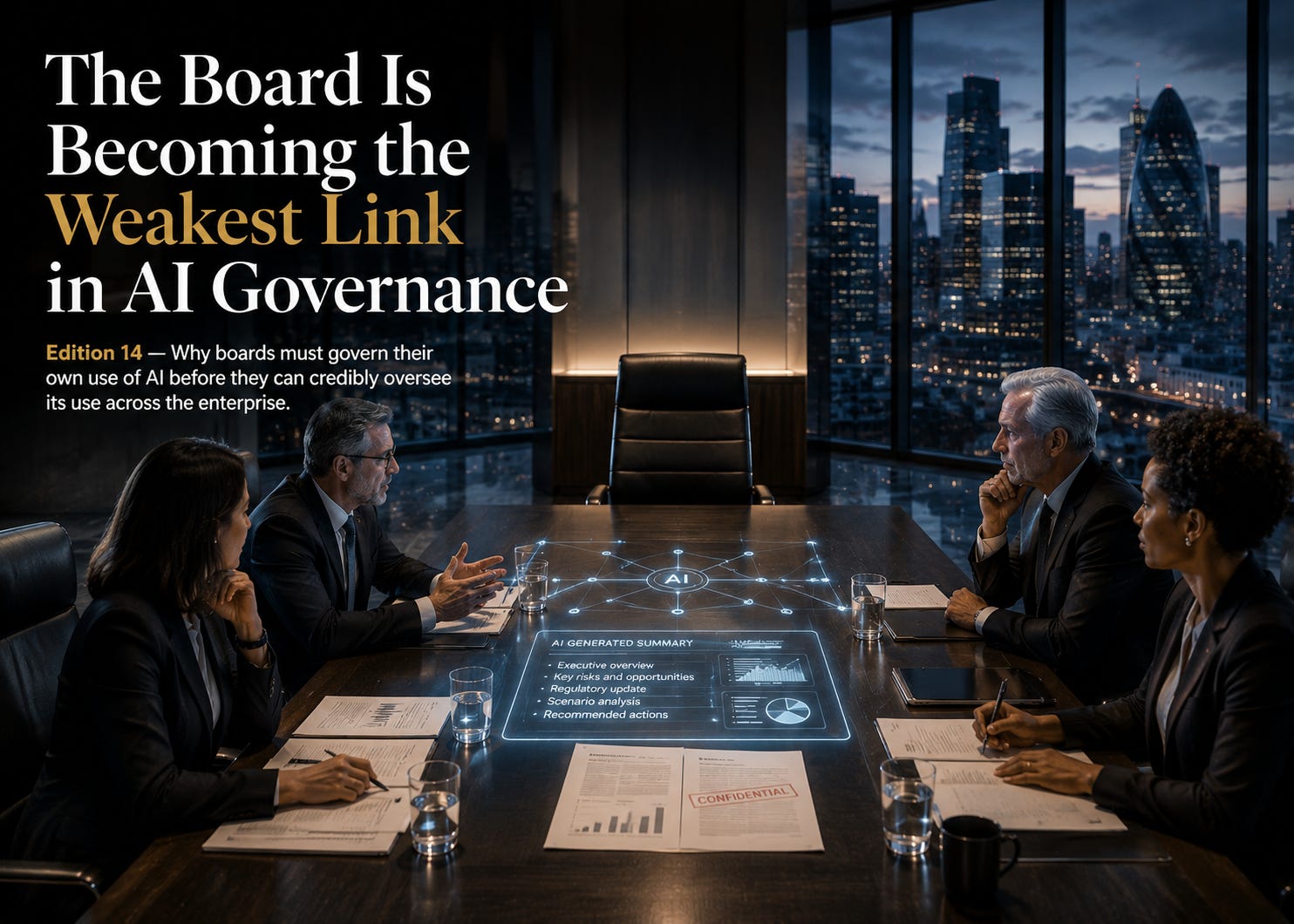
Boards are increasingly asking management how artificial intelligence is being governed across the enterprise. Far fewer are asking how AI is already influencing governance inside the boardroom itself. That distinction matters because directors are no longer observing AI adoption from a distance. They are starting to use AI tools in their own work: summarising board papers, scanning regulatory developments, comparing competitors, preparing briefing notes, drafting committee questions, and synthesising market intelligence ahead of meetings.
At one level, this is entirely rational. Boards operate in environments defined by information overload, accelerating regulation, geopolitical uncertainty, operational complexity, and constant pressure on executive decision-making. Directors are expected to absorb larger volumes of material while still exercising sound judgement, independent challenge, and long-term stewardship. AI tools can materially improve efficiency in those conditions. Used well, they may help boards process information more effectively and spend more time on strategic discussion rather than administrative burden.
The problem is that governance structures have not kept pace with adoption. Many organisations are developing enterprise AI governance frameworks covering risk management, model oversight, cybersecurity, legal exposure, workforce implications, and regulatory compliance. Yet relatively few boards have explicitly discussed how directors themselves should use AI in the execution of their governance responsibilities. That gap is becoming important because AI is no longer only a management or operational issue. It is beginning to shape how boards prepare, deliberate, analyse, and make decisions.
The result is a growing governance asymmetry. Management AI capability is accelerating rapidly across many organisations, while board oversight capability often remains immature, fragmented, or heavily dependent on management interpretation. In some organisations, the board may now be the least AI-capable part of the governance system. That creates a new category of governance risk: the risk that boards try to govern AI-enabled enterprises without first understanding how AI is already changing the work of governance itself.
AI is already reshaping board work
The boardroom is not isolated from broader AI adoption across professional work. Directors are experimenting with these tools because the practical use cases are obvious. A director preparing for a board meeting can use AI to summarise a 200-page regulatory report in minutes. Audit committee members can rapidly identify emerging themes across risk papers and external disclosures. Governance teams can compare proposed policies against evolving regulations across multiple jurisdictions. Chairs can explore strategic scenarios or test assumptions before a strategy offsite. Non-executive directors can accelerate research into competitor positioning, sector trends, or activist investor activity.
These are not speculative future applications. They are practical productivity tools that fit naturally into governance workflows, particularly where directors face high information volume and limited preparation time. Many boards have long struggled with the quality and usability of board information. The challenge is often not access to information but synthesis: which issues require judgement, which risks are material, which assumptions need to be challenged, and which decisions should be escalated. AI can support that work by helping directors organise complexity more quickly and widen the range of questions brought into the boardroom.
There is also a competitive dimension. Boards that fail to use AI intelligently may gradually become less effective than those that do. Directors operating without modern analytical tools may struggle to oversee organisations whose management teams are already embedding AI into operations, software development, customer service, procurement, forecasting, and strategic planning. A board does not need to match management’s technical depth, but it does need enough capability to challenge the strategic and governance implications of AI-enabled work. Without that capability, oversight becomes increasingly dependent on the same executives whose plans the board is supposed to test.
This is where the governance tension begins. Efficiency gains should not be confused with governance quality. Boards exist to provide judgement, challenge, oversight, stewardship, and accountability. Those responsibilities depend on critical thinking, contextual interpretation, experience, and human deliberation. AI may support those capabilities, but it cannot replace them. A board that becomes faster at processing papers while becoming less rigorous in its scrutiny has not improved governance at all.
The governance risk is not the technology alone
Most discussions about AI governance focus on enterprise systems, including model risk, regulatory exposure, data protection, algorithmic bias, and operational controls. Those issues matter, particularly in regulated industries. The board-level challenge is more subtle. The risk is that AI begins to influence governance processes in ways that weaken independent judgement without the board fully recognising it.
Generative AI systems produce fluent, persuasive, and authoritative-sounding outputs. That fluency creates psychological risk. A poorly reasoned paragraph written by a consultant may trigger scepticism because directors can often detect uncertainty, inconsistency, or weak logic. AI-generated material can appear polished and coherent even when the underlying analysis is incomplete, outdated, or wrong. In governance contexts, that presentation risk matters because directors are often working under time pressure and may use AI precisely when they need rapid synthesis.
The consequences differ sharply from ordinary consumer use. A hallucination inside a chatbot may create inconvenience. A hallucination shaping board understanding of a strategic acquisition, regulatory issue, cyber incident, or capital allocation decision creates governance exposure. The problem is not only factual error. AI-generated summaries can compress nuance, simplify trade-offs, reinforce prevailing assumptions, or omit minority perspectives that should have been tested in the boardroom. The board may receive a cleaner answer while losing sight of the uncertainty that should have shaped the discussion.
Excessive dependence on AI tools also risks weakening the capabilities boards are supposed to provide. Boards are not merely information-processing bodies. Their value lies in interpretation, challenge, judgement, scepticism, and experience. If directors increasingly outsource first-pass analysis and synthesis to AI systems, some governance processes may become faster while becoming intellectually shallower. This risk is hard to measure because it accumulates gradually. The board still appears productive: papers are reviewed, questions are generated, and discussions occur. Yet the quality of the challenge may deteriorate if directors become overly reliant on AI-generated framing.
Confidentiality creates another major governance concern. Boards routinely handle sensitive information relating to transactions, litigation, strategy, executive succession, regulatory investigations, cybersecurity incidents, and financial performance. Directors experimenting informally with public AI systems may inadvertently expose commercially sensitive information to external platforms without fully understanding how data is processed, retained, or used. In a board context, this is not a minor IT policy issue. It can become a fiduciary, legal, regulatory, and market-sensitive problem.
Boards are governing enterprise AI before governing their own use of AI
One of the more uncomfortable features of the current governance landscape is that many boards are focusing their AI oversight externally while leaving internal boardroom AI usage largely unaddressed. Boards are discussing enterprise AI policies, risk frameworks, regulatory obligations, responsible AI principles, workforce implications, and technology investment priorities. At the same time, directors may already be privately using AI tools to summarise board packs, analyse reports, prepare questions, draft notes, or explore strategic scenarios.
In many cases, there are no agreed protocols governing how these tools should be used within board and committee activities. Different directors may apply entirely different standards around verification, confidentiality, prompting, or reliance. Some may use enterprise-approved systems. Others may use public consumer tools with very different security protections. Some may heavily depend on AI-generated synthesis. Others may avoid the technology entirely. That inconsistency matters because governance processes depend on shared assumptions about rigour, accountability, and information integrity.
This creates a direct question for boards: how can a board credibly oversee enterprise AI governance if it has not governed its own use of AI? The issue is not simply operational inconsistency. It is governance visibility. Many boards may not fully understand how AI-generated outputs are already influencing board discussions, briefing preparation, committee work, or strategic interpretation. If that influence remains invisible, it cannot be governed properly.
The comparison with early cybersecurity governance is useful, but incomplete. Many boards initially treated cyber risk as a technical issue, largely delegated to IT functions, until major breaches exposed governance failures at the board level. AI presents a broader challenge because it affects organisational economics, workforce structures, strategic positioning, customer interaction models, risk controls, and decision-making itself. Traditional committee structures struggle with technologies that cut across so many domains simultaneously. AI governance, therefore, cannot sit neatly inside IT, risk, compliance, or strategy alone.
The next phase of AI governance will focus on board effectiveness
The answer is not to prohibit directors from using AI. That would be unrealistic and strategically counterproductive. Nor should boards allow unrestricted experimentation under the assumption that productivity gains automatically improve governance. The next phase of AI governance maturity will focus on disciplined augmentation: using AI in ways that strengthen board effectiveness without weakening judgement, accountability, or oversight quality.
Boards should start by acknowledging reality. AI is already inside governance processes, whether formally recognised or not. Silence leaves usage patterns informal, inconsistent, and unmanaged. A mature board should ask how directors, committees, company secretaries, and governance teams are currently using AI tools; which tools are approved; what information may be entered; which outputs require verification; and where AI use should be prohibited because the confidentiality, privilege, or decision risk is too high. This is basic governance hygiene, not bureaucratic overreach. As a first step, boards should commission a short review of how AI is currently being used by directors, committees, company secretaries, and governance teams.
Boards should then establish clear principles governing acceptable AI use within board and committee activities. These principles do not need to become long policy documents. They should clarify the boundaries for confidentiality, verification, acceptable use cases, reliance, and disclosure, where relevant. For example, using AI to summarise a public regulatory consultation may be low risk. Uploading confidential transaction papers into an unapproved public tool is a different matter. Using AI to generate potential challenge questions may improve preparation. Treating AI-generated analysis as validated advice on a complex legal, financial, or regulatory matter would be poor governance.
AI literacy also matters increasingly at board level. Directors do not need deep technical expertise, but they do require sufficient understanding to challenge assumptions, interpret limitations, assess strategic implications, and credibly oversee AI-enabled organisations. This is not a training issue in the narrow sense. It is part of board effectiveness. A board that lacks confidence in interrogating AI-related claims may gradually become dependent on management narratives, vendor assurances, or superficial dashboard reporting. That weakens oversight at precisely the point when AI is becoming more material to strategy, risk, and operating performance.
Most importantly, boards should focus on preserving the human dimensions of governance that technology cannot replicate. AI can improve efficiency, synthesis, and analytical support. It cannot provide fiduciary accountability, moral judgement, stakeholder stewardship, or contextual wisdom developed through experience. The objective should not be to maximise automation of governance activities. It should involve stronger challenges, better preparation, broader strategic thinking, and more effective oversight.
AI will almost certainly become a permanent feature of modern governance practice. Boards that ignore it may become progressively less effective in complex operating environments. Boards that use it carelessly may weaken governance quality without realising it. The challenge for modern boards is to use AI in ways that strengthen judgement, accountability, and strategic effectiveness simultaneously.
Boards are now entering a phase where AI governance will test their own effectiveness as much as management’s. If you want sharper board-level analysis on AI strategy, governance, and transformation, subscribe to AI in the Boardroom. Future editions will continue to focus on the practical questions directors cannot afford to delegate.