


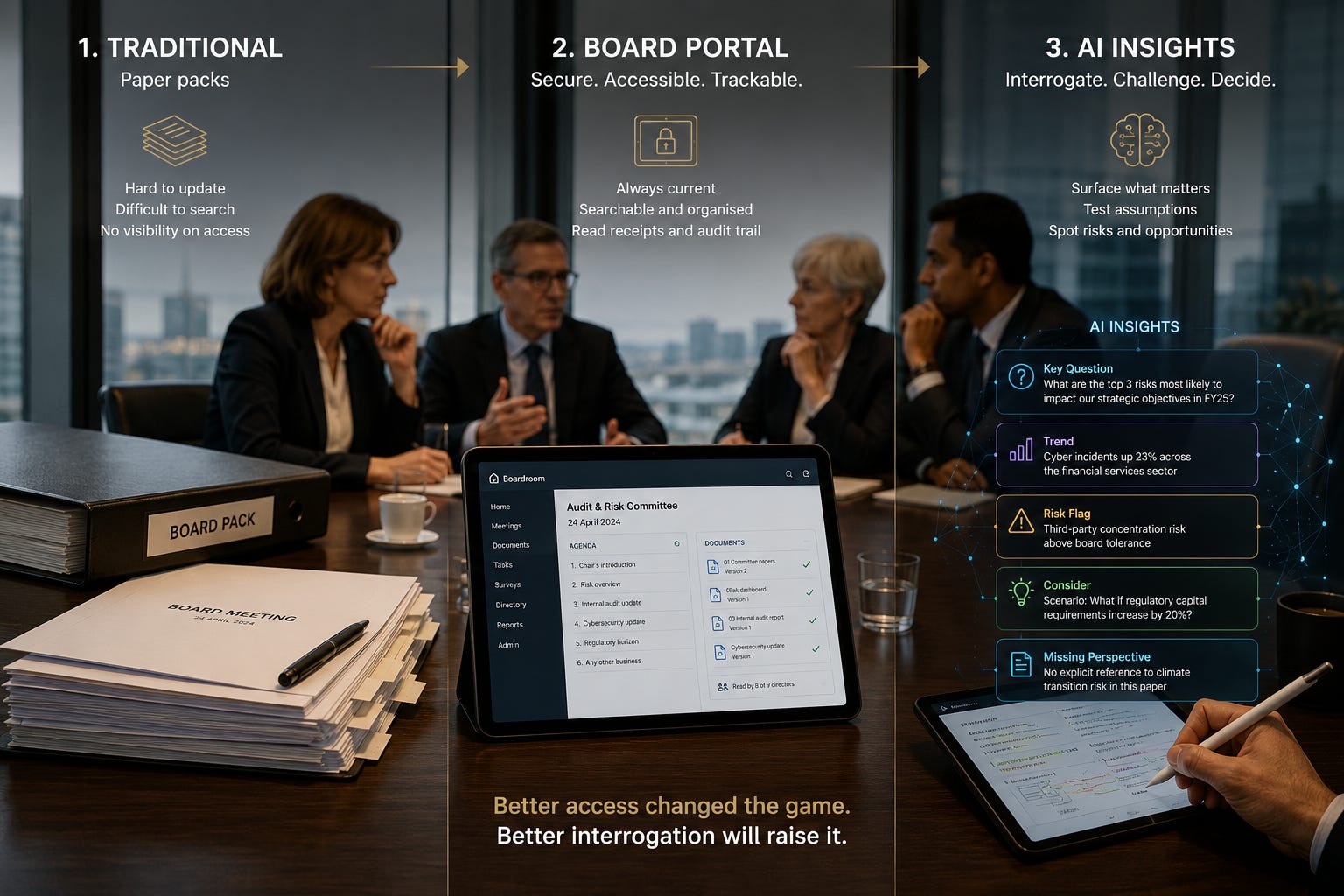
Boards do not suffer from a shortage of information. Most suffer from the opposite problem. Directors are expected to absorb large board packs, monitor complex risks, understand shifting regulations, challenge management, oversee strategy and still reserve enough mental space for judgement. The problem is not simply volume. It is that too much board time is spent processing information that should have been clarified, synthesised or challenged before it reached the boardroom.
The next shift in board information
It is easy to forget that, until recently, the board pack was a physical object. For decades, directors arrived at meetings with ring binders, marked-up papers, couriered updates and last-minute inserts. The process was familiar but slow, insecure, and poorly suited to a governance environment in which boards were meeting more often, handling more information, and facing greater accountability. Board portals changed the mechanics of that work. Papers could be distributed securely, updated quickly, searched, archived and tracked. Company secretaries gained better control over versioning and circulation. Directors could access material wherever they were, and the system could create an audit trail around receipt and access.1
Board portals did not make directors better by themselves. They changed the information infrastructure of governance. AI now creates a similar moment, but at a different level. Board portals changed how directors received information. AI will change how directors interrogate it.
That distinction matters. AI should not be treated as a clever assistant that writes summaries and saves time, although it can do both. Its more important contribution is to help directors ask better questions, test assumptions, compare options and spot what may be missing from the material in front of them. Used well, AI can improve preparation, sharpen challenges, and reduce some of the administrative drag that slows down governance work. Used badly, it can create false confidence, expose sensitive information, weaken accountability and make poor analysis look more convincing than it is.
AI is already entering the governance system
AI is no longer a theoretical boardroom topic. Lloyds Banking Group has reportedly begun using an AI-powered board adviser developed by Board Intelligence to help executives and board members process confidential information, prepare for high-level meetings and bring broader perspectives to decision-making.2 The reported use is deliberately framed as augmentation rather than legal decision-making authority. Mubadala, the Abu Dhabi state-owned investment company, has also reportedly installed a homegrown AI tool called Maia to support its investment committee and encouraged portfolio companies to deploy Maia as an observer at board level.3
What is striking is not simply that large institutions are experimenting. It is that the use case has moved into the governance system itself: board papers, committee preparation, meeting analysis, director briefing and decision support. The Financial Times has reported that when Diligent began asking boards about AI directors, the idea initially felt “very Star Trekkie” to many, but board members have since become more open to it. Board Intelligence’s Pippa Begg described a similar change among FTSE 100 clients, moving from “I’m not going to do anything” to “I think we need to do something. How do we do it safely and securely?”4
That is the real boardroom question. The issue is not whether AI can be useful. It can. The issue is whether boards will shape its use deliberately, or allow informal habits to emerge without clear rules, safeguards or accountability.
Use AI to strengthen inquiry, not replace judgement
The safest and most useful applications are those that support preparation, synthesis and inquiry. A director might use an approved AI tool to summarise a non-confidential industry report, compare strategic options, generate questions ahead of a risk committee meeting or identify what appears to be missing from a management paper. A company secretary might use AI to prepare a first draft of a governance note, create a board briefing from publicly available regulatory material, or track themes across committee actions.
AI can also improve the quality of challenge. A director reviewing a capital investment proposal could ask the tool to identify the assumptions that must hold true for the proposal to succeed. A remuneration committee member could use it to prepare questions about incentive design, fairness or unintended consequences. A board considering an AI investment could ask for alternative risk scenarios before management presents the preferred case. These uses are valuable because they strengthen human inquiry. They do not ask AI to make the decision. They use AI to improve the director’s preparation for the decision.
The risks boards need to control
The risks are equally clear. The first is accuracy. AI tools can produce outputs that are incomplete, outdated, biased or wrong. The danger is made worse by fluency. A poor answer expressed confidently can be more dangerous than an obviously weak one. Directors should therefore treat AI outputs as working material, not evidence.
The second risk is confidentiality. Boards handle information on strategy, performance, transactions, litigation, people, remuneration and regulatory matters. Uploading board papers or sensitive material into unapproved public AI tools may create legal, regulatory and reputational exposure. If directors use AI informally without clear guidance, the organisation may have sensitive governance work taking place outside its own control environment.
The third risk is accountability. Directors remain responsible for their decisions even when AI has helped with research, drafting or analysis. AI cannot understand fiduciary duty, organisational context, stakeholder nuance, or board dynamics as a director must. It can support the work, but it cannot carry the responsibility.
What boards should require before adoption
Boards should therefore adopt a simple principle: AI may support directors’ work, but it must not become an invisible participant in governance. If AI has contributed to board material, the board should know where it was used, what it was used for and what verification was applied. The standard should be proportionate. Using AI to improve the wording of a general briefing note is not the same as using it to interpret legal obligations, assess financial resilience or summarise confidential transaction papers.
The practical steps are not complicated. Boards should agree on a short acceptable-use policy for directors, committees and governance professionals. This should cover approved tools, prohibited use cases, confidentiality rules, verification expectations and escalation routes. It should also require AI-assisted board material to disclose the nature of AI use where that use is material to the analysis or recommendation.
Boards should then identify a small number of useful, low-risk use cases. Good starting points include summarising public regulatory updates, preparing draft questions for management, producing first-pass briefings from non-confidential material and supporting routine governance administration. These use cases should be reviewed after a short period to understand where AI added value, where it created risk and where human review remained essential.
Directors and governance teams should receive practical training. This should focus on real boardroom scenarios rather than technical theory. Directors should learn how to prompt effectively, test outputs, protect confidential information, and recognise when AI is the wrong tool for the task.
The board should also ask management how AI is being used in governance processes more broadly. This includes board pack production, risk reporting, internal audit, legal review, committee support and management reporting. AI use within the governance system should itself be visible to the board.
The real test: better governance, not more technology
AI can make boards more effective, but not by replacing directors or automating judgement. Its value lies in helping directors prepare better, analyse faster, see more perspectives and ask sharper questions. It can reduce the time spent on low-value information processing and increase the time available for the work only directors can do: judgement, challenge, stewardship and accountability.
The boards that benefit most will not be those that use AI most aggressively. They will be those who use it deliberately, safely and in the service of better governance. If your board is beginning to explore AI, start with the governance work closest to the boardroom: papers, preparation, challenge, assurance and decision-making. The organisations that benefit will not be those that use AI most enthusiastically, but those that use it with discipline. For boards, the first question is not “What AI tools should we use?” It is “What parts of our governance work need better judgement, sharper challenge or stronger control?”
Subscribe to AI in the Boardroom for practical, board-level thinking on AI strategy, governance and transformation — written for directors who want to turn AI disruption into a strategic advantage.
https://en.wikipedia.org/wiki/Board_portal
https://www.thetimes.com/business/companies-markets/article/robot-ai-lloyds-bank-boardroom-nwznbbpnw
https://www.thenationalnews.com/business/2026/01/20/how-an-ai-bot-changed-the-way-mubadala-invests/
https://www.ft.com/content/082192c1-a888-4000-8796-020c83a2b4f3?syn-25a6b1a6=1